
Search for:

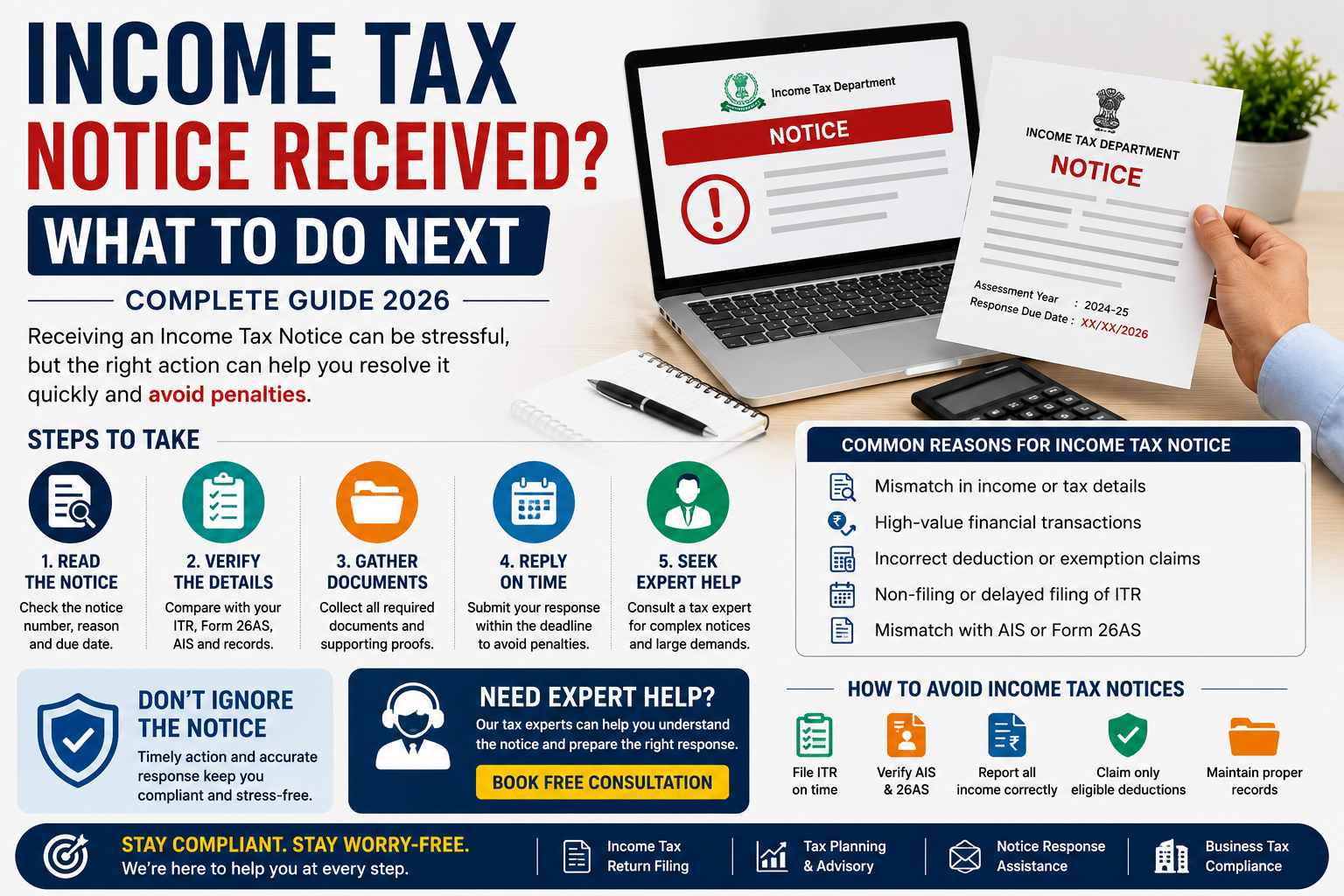
Income Tax Notice Received? What to Do Next (Complete Guide 2026)

Receiving an Income Tax Notice can be stressful, but it doesn’t always mean you’ve done something wrong. Many notices are issued to seek clarification, verify information, or request additional documents. The key is to understand the notice, respond within the deadline, and take appropriate action.


In this guide, we’ll explain why you may receive an income tax notice, the different types of notices, and the steps to resolve them efficiently.

What is an Income Tax Notice?

An Income Tax Notice is an official communication sent by the Income Tax Department when it requires information, clarification, or action from a taxpayer.

You may receive a notice due to:

• Errors in your Income Tax Return (ITR)

• Mismatch between reported income and Form 26AS or AIS

• Unreported high-value transactions

• Non-filing or delayed filing of ITR

• Incorrect deduction or exemption claims

Receiving a notice doesn’t automatically mean you owe additional tax, but you should respond promptly.

Common Reasons for Receiving an Income Tax Notice

Some of the most common reasons include:

• Failure to file ITR before the due date

• Mismatch in TDS details

• High-value financial transactions

• Incorrect deduction claims under Sections 80C, 80D, etc.

• Income mismatch with AIS or Form 26AS

• Scrutiny assessment by the Income Tax Department

Types of Income Tax Notices

Notice for Non-Filing of ITR

Issued when a taxpayer has not filed an Income Tax Return despite being liable to do so.

Defective Return Notice

Sent when the filed return contains errors or missing information.

Scrutiny Notice

Issued when the department wants to examine your return in detail.

Demand Notice

Issued if additional tax, interest, or penalty is payable.

Reassessment Notice

Sent if the department believes income has escaped assessment.

How to Avoid Income Tax Notices

Follow these best practices:

✔ File your ITR before the due date

✔ Verify Form 26AS and AIS before filing

✔ Report all income sources accurately

✔ Claim only eligible deductions

✔ Maintain proper financial records

✔ Reconcile TDS details

Received an Income Tax Notice?

Don’t ignore it. Get expert assistance from Digihunter’s verified tax professionals to review your notice, prepare a response, and ensure compliance before the deadline.

What Should You Do After Receiving an Income Tax Notice?

Read the Notice Carefully

Check: Notice number Assessment Year Reason for the notice Due date for response

Verify the Information

Compare the notice with: Income Tax Return Form 26AS Annual Information Statement (AIS) Salary slips Bank statements

Gather Supporting Documents

Prepare: PAN Card Income proof Investment proofs Tax payment challans Bank statements Form 16/Form 16A

Respond Within the Deadline

Most notices have a specific response timeline. Missing the deadline may lead to penalties or further proceedings.

Seek Professional Assistance

If the notice involves: Scrutiny assessment Large tax demand Capital gains Business income International transactions consult a qualified tax professional before submitting your response.

Conclusion

Receiving an Income Tax Notice should not cause panic. The most important steps are understanding the reason, reviewing your records, and responding accurately within the prescribed time. Proper documentation and timely action can help resolve most issues smoothly.

Professional guidance can simplify the process, reduce stress, and help ensure full compliance with tax regulations.

Need expert tax planning or notice response assistance? Connect with verified tax professionals through Digihunter today.

✅ Income Tax Notice Response

✅ ITR Filing & Revision

✅ Tax Planning

✅ Business Tax Compliance

Contact Form

Tax Planning for Married Couples in India (Complete Guide 2026)

Marriage not only changes your personal life but also impacts your financial planning. With proper strategies, married couples can legally reduce their tax liability, optimize investments, and build wealth together.

In this guide, we explain tax planning for married couples in India for 2026, including deductions, joint strategies, and smart tax-saving tips.

Why Tax Planning is Important for Married Couples


Married couples can benefit from:

✔ Better tax-saving opportunities
✔ Efficient income distribution
✔ Joint financial planning
✔ Increased deductions and exemptions


Proper planning ensures both partners maximize their tax benefits.

👉 For expert help, explore Income Tax Return Filing Services on Digihunter.

Utilize Section 80C for Both Partners


Each spouse can claim up to ₹1.5 lakh under Section 80C.


Together, couples can claim up to:

👉 ₹3 lakh deduction

Options include:

  1. ELSS investments
  2. PPF contributions
  3. Life insurance premiums
  4. Home loan principal repayment

Claim Health Insurance Under Section 80D


Couples can maximize deductions by:

  • Taking a family health insurance plan
  • Claiming separate deductions if both pay premiums
  •  

Deduction:

  • ₹25,000 for self & spouse
  • Additional ₹25,000–₹50,000 for parents

👉 Get personalized tax planning advice from Digihunter experts and save more together.

Plan Home Loan Benefits Smartly


If both spouses are co-owners of a property:

Each can claim:

  • ₹1.5 lakh under Section 80C (principal)
  • ₹2 lakh under Section 24(b) (interest)

👉 This doubles the tax benefit significantly.

Split Income and Investments


Distribute investments strategically:

✔ Invest in the name of the lower-income spouse
✔ Reduce overall tax liability
✔ Avoid clubbing provisions (plan carefully)

Optimize HRA and Rent Planning


If living in a rented house:

✔ Both spouses can claim HRA (if applicable)
✔ Ensure proper rent agreements

If owning property:

✔ Combine HRA + home loan benefits (if eligible)

Choose the Right Tax Regime Individually


Each spouse can independently choose:

  • Old Tax Regime (with deductions)
  • New Tax Regime (lower rates)
  •  

👉 Evaluate separately for maximum benefit.

Invest for Long-Term Goals Together


Plan jointly for:

1.Retirement
2.Children’s education
3.Wealth creation


Options include:

1.Mutual funds
2.PPF
3.NPS

Gift and Tax Planning


Spouses can transfer money without tax implications.

✔ Gifts between spouses are tax-free
✔ Income generated may be taxable (clubbing rules apply)

👉 Explore Tax Planning Services on Digihunter to create a personalized strategy for couples.

Conclusion:

Tax planning for married couples offers unique opportunities to maximize deductions, reduce tax liability, and build wealth together.

By utilizing Section 80C, health insurance benefits, home loan deductions, and strategic investments, couples can achieve better financial outcomes.

Contact Form
Infographic explaining insurance tax benefits in India for 2026, covering Sections 80C, 80D, 10(10D), and key savings on life and health insurance premiums.

Insurance Tax Benefits Explained (Complete Guide for 2026)

Insurance is not just about financial protection—it also offers significant tax-saving benefits under the Income Tax Act. Many taxpayers invest in insurance policies but fail to fully utilize the available deductions.

In this guide, we explain insurance tax benefits in India, including sections, limits, and how to maximize your savings in 2026.

Why Insurance is Important for Tax Planning

Insurance helps you:

✔ Protect your family financially
✔ Reduce taxable income
✔ Plan long-term financial security
✔ Combine risk coverage with tax savings

Proper planning ensures you get both protection and tax benefits.


👉 For expert help, explore Income Tax Return Filing Services on Digihunter.

Section 80C – Life Insurance Premium

Under Section 80C, you can claim deductions on life insurance premiums.


Key Points:

  1. Maximum deduction: ₹1.5 lakh.
  2. Applicable for self, spouse, and children.
  3. Policy must meet premium-to-sum assured ratio.

💡 This is one of the most commonly used tax-saving options.

Section 80D – Health Insurance Premium

Health insurance provides tax benefits along with medical security.

Deduction Limits:

  • ₹25,000 (self, spouse, children)
  • ₹25,000 (parents)
  • ₹50,000 (senior citizen parents)
  •  

Additional Benefit:

✔ Preventive health check-up expenses included

Section 10(10D) – Tax-Free Insurance Maturity

Maturity proceeds of life insurance policies are:

✔ Fully tax-free (subject to conditions)

Conditions include:

  1. Premium should not exceed a certain percentage of sum assured.

This makes life insurance a tax-efficient investment.

Section 80DD – Dependent Disability Insurance

You can claim deductions if you have insurance for a dependent with disability.

Deduction:

  • ₹75,000 (normal disability)
  • ₹1,25,000 (severe disability)

Section 80DDB – Critical Illness Treatment

Expenses for specified diseases are eligible for deduction.

✔ Covers major illnesses
✔ Deduction depends on age and condition

ULIP Tax Benefits

Unit Linked Insurance Plans (ULIPs) offer:

✔ Tax deduction under 80C
✔ Tax-free maturity (with conditions)

However, high premium ULIPs may be taxed differently as per latest rules.

Key Tips to Maximize Insurance Tax Benefits

✔ Choose adequate coverage (not just for tax saving)
✔ Combine term plan + health insurance
✔ Avoid over-investing only for deductions
✔ Keep proper documentation

Common Mistakes to Avoid

❌ Buying insurance only for tax saving
❌ Ignoring policy conditions
❌ Not renewing policies on time
❌ Choosing low coverage

Always prioritize protection first, tax saving second.

Need expert tax planning assistance? Connect with verified professionals via Digihunter today.

Contact Form

Conclusion

Insurance is a powerful tool that provides financial security and tax-saving benefits. By understanding Sections 80C, 80D, and 10(10D), you can effectively reduce your tax liability while protecting your family.

Smart insurance planning is a key part of overall financial planning.

Tax Planning for NRIs in India (Complete Guide 2026)

Non-Resident Indians (NRIs) often face confusion regarding taxation in India. With income sources in India such as rent, capital gains, or investments, proper tax planning becomes essential to avoid double taxation and reduce tax liability legally.


In this guide, we explain tax planning for NRIs in 2026, including income tax rules, deductions, and strategies to optimize taxes.

Who is an NRI for Tax Purposes?


An individual is considered an NRI based on residential status under the Income Tax Act.

Generally, you are an NRI if:

✔ You stay in India for less than 182 days in a financial year
✔ You meet other residency conditions as per tax laws

Your tax liability depends on your residential status.

Taxable Income for NRIs in India

NRIs are taxed only on income earned or received in India.

Common taxable income includes:

  1. Salary received in India
  2. Rental income from property
  3. Capital gains from sale of assets
  4. Interest from Indian bank accounts

Income earned outside India is generally not taxable in India.

Confused about NRI tax rules and compliance?


👉 Get expert NRI tax consultation through Digihunter and avoid double taxation issues.

Tax Deducted at Source (TDS) for NRIs

TDS is applicable at higher rates for NRIs:

  1. Rental income – subject to TDS
  2. Capital gains – TDS applicable at prescribed rates
  3. Interest income – TDS deducted by banks

NRIs can claim refunds by filing Income Tax Returns (ITR).

Double Taxation Avoidance Agreement (DTAA)

India has DTAA agreements with many countries to avoid double taxation.

Benefits include:

✔ Avoid paying tax twice
✔ Lower tax rates in some cases
✔ Tax credit in resident country

NRIs must submit Tax Residency Certificate (TRC) to claim DTAA benefits.

Deductions Available for NRIs

NRIs can claim several deductions under the Income Tax Act:

Section 80C:

  1. ELSS
  2. Life insurance
  3. Principal repayment of home loan

Section 80D:

  1. Health insurance premiums

Section 24(b):

  1. Home loan interest (up to ₹2 lakh)

These deductions help reduce taxable income.

Capital Gains Tax for NRIs

NRIs are subject to capital gains tax on:

  • Property sale
  • Shares and mutual funds

Key points:

✔ Long-term and short-term gains taxed differently
✔ Indexation benefits available (for property)
✔ Reinvestment options available under tax provisions

NRI Bank Accounts and Taxation

NRIs can maintain:

  • NRE Account (tax-free interest)
  • NRO Account (taxable interest)
  • FCNR Account

Choosing the right account helps optimize taxes.

Filing Income Tax Return for NRIs

NRIs must file ITR if:

✔ Total income exceeds basic exemption limit
✔ They want to claim tax refund
✔ They have capital gains

Filing returns ensures compliance and avoids penalties.

Common Mistakes NRIs Should Avoid

❌ Not checking residential status
❌ Ignoring DTAA benefits
❌ Not filing ITR for refund
❌ Incorrect TDS handling

Avoiding these mistakes ensures smooth tax compliance.

Contact Form

Conclusion

Tax planning for NRIs requires understanding Indian tax laws, DTAA benefits, and available deductions. With proper planning, NRIs can reduce tax liability, avoid double taxation, and stay compliant.

Professional guidance ensures accurate filing and maximum tax savings.